
Residential vs. Commercial Roofing: What’s the Difference?
If you’ve ever assumed that roofing is simply roofing — that the same materials, techniques, and expertise apply whether you’re covering a family home or a large commercial building — you’re not alone. It’s one of the most common misconceptions property owners have. The reality is that residential and commercial roofing are distinct disciplines, each with its own materials, design requirements, installation methods, and maintenance demands. For property owners in Vero Beach, understanding these differences isn’t just interesting — it’s essential for making smart decisions about one of your biggest investments.
It Starts With the Roof’s Shape
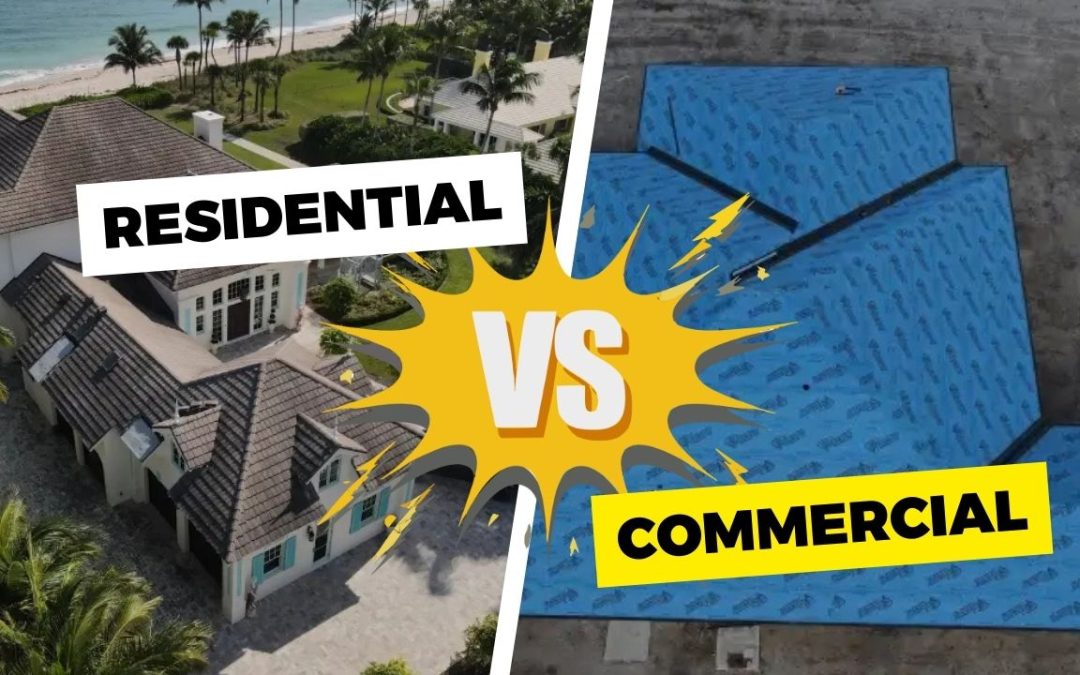
The most visible difference between residential and commercial roofing is the pitch, or slope, of the roof itself. Residential homes are almost universally built with steep-slope roofs — the classic triangular shape you picture when you think of a house. That slope exists for a reason: it sheds water quickly and naturally, channeling rain into gutters and away from the structure. The steep pitch also allows for a wide variety of visually appealing materials, which matters in residential neighborhoods where curb appeal directly affects property value.
Commercial buildings, on the other hand, are typically constructed with flat or low-slope roofs. This design makes sense for large structures where a steeply pitched roof would be impractical and prohibitively expensive to build. Flat roofs also offer functional advantages — they provide accessible space for HVAC equipment, solar panels, and other mechanical systems that need to be kept off the ground. The tradeoff is that flat roofs don’t shed water the same way a pitched roof does, which means drainage design becomes critically important, especially in a high-rainfall environment like Vero Beach.
Residential Roofing: Materials and Priorities
For homes in the Vero Beach area, the most common roofing materials are asphalt shingles, concrete or clay tile, and metal roofing. Each has its own strengths in Florida’s climate.
Asphalt shingles remain the most widely used residential roofing material in the country due to their affordability and ease of installation. Modern architectural shingles offer significantly improved durability over the three-tab shingles of decades past, and many are now manufactured with algae-resistant properties — a major plus in humid coastal environments. The downside is that asphalt is more susceptible to UV degradation and wind damage than some alternatives, making proper installation and regular maintenance especially important here.
Concrete and clay tile are extremely popular throughout South Florida for good reason. Tile roofs are exceptionally durable, naturally resistant to fire, insects, and rot, and hold up well under UV exposure. They also have a distinctive aesthetic that complements the Mediterranean and Spanish-style architecture common in the region. The primary considerations with tile are weight — older homes may require structural reinforcement to support a tile roof — and the importance of the underlayment beneath the tiles, which does the actual waterproofing work and needs periodic inspection.
Metal roofing has grown rapidly in popularity among Florida homeowners over the past decade, and it’s easy to understand why. Standing seam metal roofs in particular offer outstanding wind resistance, excellent longevity, and high reflectivity that helps reduce cooling costs during hot Florida summers. They’re also highly resistant to the salt air corrosion that affects coastal properties. The higher upfront cost compared to shingles is often offset by the significantly longer lifespan and lower long-term maintenance requirements.
For residential projects, aesthetics play a meaningful role alongside performance. A roof has to function flawlessly, but it also has to look right for the home and neighborhood. Color, texture, profile, and style all factor into material selection in ways that simply don’t apply to most commercial projects.
Commercial Roofing: Materials and Priorities
Commercial roofing operates under a different set of priorities. On a flat or low-slope roof, the focus shifts almost entirely to waterproofing performance, long-term durability, and ease of maintenance. The materials used reflect those priorities.
TPO (Thermoplastic Polyolefin) has become one of the most widely used commercial roofing membranes in the industry. It’s a single-ply material that is heat-welded at the seams to create a watertight bond, and its white or light-colored surface reflects sunlight effectively, reducing cooling loads on large commercial buildings — a significant advantage in Florida’s heat. TPO is also relatively lightweight and resistant to UV radiation, making it a strong performer in the Vero Beach climate.
Modified bitumen is a multi-layer system derived from traditional built-up roofing that offers excellent durability and waterproofing. It’s particularly well-suited to roofs with heavy foot traffic from maintenance personnel accessing rooftop equipment, as it holds up well under wear. Modified bitumen systems can be installed using torch-applied, cold-adhesive, or self-adhering methods, giving contractors flexibility based on building requirements.
Metal roofing systems also appear frequently on commercial structures, particularly on buildings with some slope or on retail and industrial properties where standing seam panels provide a clean, professional appearance alongside strong performance. Metal’s longevity and low maintenance requirements make it attractive for commercial property owners focused on minimizing long-term operating costs.
What all of these commercial systems share is an emphasis on seamless, reliable waterproofing above all else. A small leak in a home is stressful and damaging. A small leak in a commercial building can disrupt business operations, damage inventory or equipment, create liability concerns, and affect the health and safety of employees and customers. The stakes are simply higher, and the roofing systems are engineered accordingly.
Installation: A Very Different Process
Beyond materials, the actual installation process differs substantially between residential and commercial work. Residential roofing on a steep-slope home is generally faster and more straightforward — a skilled crew can often complete a full residential re-roof in a single day or two, with minimal disruption to the occupants.
Commercial roofing projects are a different undertaking entirely. Large flat roofs require careful planning around drainage layout, membrane seaming, penetrations for rooftop equipment, and edge detailing. The work often needs to be phased or scheduled carefully to avoid disrupting active business operations below. Waterproofing details around HVAC curbs, drains, skylights, and other penetrations require precision because each one represents a potential weak point in the system.
Permitting and code compliance also tend to be more involved on commercial projects, particularly in Florida where building codes are among the most stringent in the country following decades of hurricane experience. Working with a contractor who understands Florida’s commercial roofing requirements isn’t optional — it’s essential.
Maintenance: Prevention Looks Different Too
Both residential and commercial roofs benefit enormously from regular inspections and preventative maintenance, but what that maintenance looks like differs between the two.
For residential roofs, annual inspections focused on shingle condition, flashing integrity, gutter function, and signs of biological growth cover most of the bases. After major storms, a follow-up inspection is always wise.
Commercial roofs typically benefit from a more structured maintenance program — often twice-yearly inspections plus post-storm checks. Drainage systems need to be kept clear because a clogged drain on a flat roof can lead to ponding water, which adds significant weight and accelerates membrane deterioration. Seams, flashings, and penetrations need regular evaluation because those are the areas where failures most commonly begin. Many commercial property owners invest in maintenance agreements with their roofing contractor, which ensures consistent attention and often qualifies them for extended manufacturer warranties.
Why Choosing the Right Contractor Matters
Not every roofing contractor is equally experienced in both residential and commercial work. The materials, techniques, code requirements, and project management demands are different enough that specialization matters. A contractor who excels at residential shingle work may not have the experience with TPO membrane installation or commercial drainage design to serve a business owner well — and vice versa.
At Cutting Edge Roofing, we specialize in both residential and commercial roofing throughout Vero Beach and the surrounding Treasure Coast. Our team understands the demands Florida’s climate places on every type of roofing system, and we match the right materials, methods, and maintenance approach to each individual property. Whether you’re a homeowner looking to replace an aging shingle roof or a commercial property owner managing a large flat roof system, we bring the same commitment to quality and long-term performance to every project.
The roof over your head — whether it’s over your family or your business — deserves expertise built for Florida. Contact Cutting Edge Roofing today to discuss your project and schedule a professional assessment.